Spain's high-speed rail network is good enough that flying domestically is usually the wrong call — slower door-to-door once you count the airport, and rarely cheaper. That said, "usually" isn't "always," and there's a specific, short list of situations where booking a domestic flight is genuinely the smarter move.
The default: take the train
For anywhere the AVE network reaches directly — Madrid above all, but also most major Spanish cities on the core high-speed spine — rail wins the door-to-door math almost every time. City-center station to city-center station beats airport transfer, security, boarding and deplaning at the other end, even before accounting for the train's more comfortable, more reliable experience. If a destination has a direct high-speed line, that's your answer; don't overthink it.
Where flying actually wins
The calculus flips once a destination is far enough that rail has no fast direct option. Seville is the clearest case within reach of a Barcelona-based trip: a flight on Iberia or Vueling runs roughly 1 hour 20 minutes, against a train ride of 5.5+ hours with no direct high-speed line covering that specific route well. The Canary Islands aren't a rail question at all — trains don't reach them, full stop, so flying (or a very long ferry) is the only option if they're on your itinerary. Bilbao sits in similar territory to a lesser degree: roughly a 1 hour 25 minute flight against something like 6 hours by train, worth considering if a Basque Country extension is part of a longer Spain trip beyond this site's Catalonia/Madrid focus.
The door-to-door math
When you're genuinely unsure which way to go, run the comparison the same way each time: airport transfer time plus security plus the flight itself plus deplaning and transfer at the other end, against station-to-station train time plus whatever it takes to get to and from each station. For any route with a strong direct AVE connection, the train wins this comparison even when the raw flight time looks shorter on paper — airports simply add more friction at both ends than train stations do. The flight only pulls ahead once the train leg alone would run five-plus hours, which is roughly the threshold where flying starts to make sense for this audience.
A couple more borderline cases
Valencia sits in genuinely competitive territory — the AVE covers it in under 2 hours from Barcelona, fast enough that the train wins for most travelers despite Valencia being a reasonable flight option too; default to rail here unless your schedule is unusually tight. Granada is a tougher call: no direct high-speed line from Barcelona means a longer rail journey with a connection, which tips some travelers toward flying even though it isn't in the same clear-cut category as Seville or the Canaries — worth pricing both ways for your specific dates rather than assuming either is obviously right.
Booking domestic flights
Iberia and Vueling operate the bulk of Spain's domestic network, with routes and frequencies that shift seasonally — treat any specific schedule or fare as something to check fresh rather than plan around months in advance. Domestic flights inside Spain tend to be short-haul, no-frills affairs; pack accordingly and expect the usual budget-carrier baggage rules on Vueling specifically, which are stricter than what US travelers are used to on domestic legs at home.
What flying inside Spain is actually like
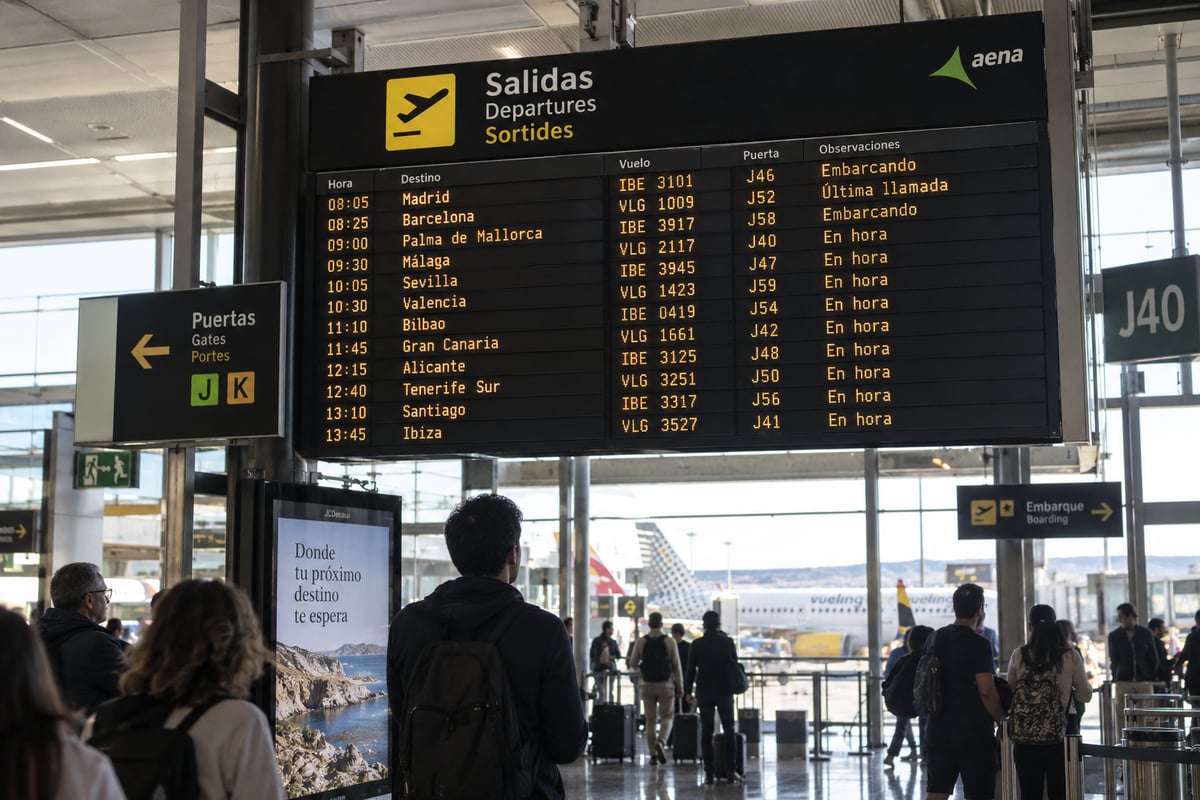
Domestic terminals at major Spanish airports run efficiently by international standards — security lines are typically shorter than what you'd expect at a US domestic airport, and boarding processes are brisk on the low-cost carriers especially, since turnaround speed is part of their business model. That efficiency is part of why the threshold for flying beating the train sits as high as it does: even a genuinely fast domestic flight process still adds more fixed overhead than simply walking onto a train platform, which is the whole reason rail keeps winning until a route gets long enough that no amount of airport efficiency can close the gap.
The bottom line
Default to the train for anything the AVE network covers directly — it's faster once you count the airport, and it's simply a better experience. Reach for a domestic flight only when the destination is genuinely far enough that rail can't compete: Seville, the Canary Islands, or a Bilbao extension on a longer trip. Everywhere else, the train is the right call, not the compromise.
FAQ
Is it better to fly or take the train from Barcelona to Madrid?
The train, almost always — AVE covers Madrid in about 2.5-3 hours city-center to city-center, beating a flight once airport transfer and security are factored in.
Should I fly from Barcelona to Seville?
Yes, generally — a flight runs about 1 hour 20 minutes versus a 5.5+ hour train with no strong direct high-speed connection on that specific route.
Can I take a train to the Canary Islands from Barcelona?
No — the Canary Islands aren't connected by rail at all. Flying (or a very long ferry) is the only way to reach them.
Which airlines fly domestic routes in Spain?
Iberia and Vueling operate the majority of Spain's domestic network, with routes and frequency that shift seasonally.
Is Vueling a budget airline?
Yes — expect stricter, less generous baggage rules than typical US domestic carriers, so check the fare's included allowance before booking.
Keep planning
Not sure how the slots fit together?
Pick your trip length and we'll route a real day-by-day plan around the timed entries.