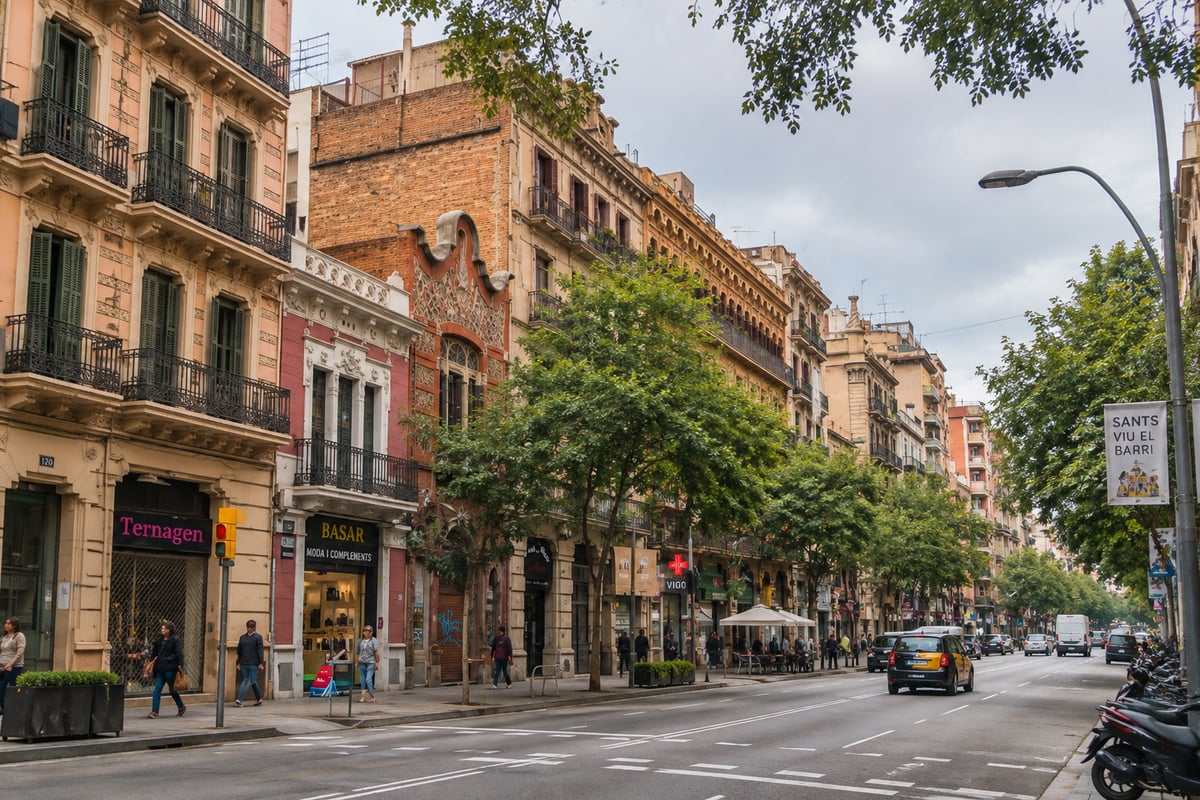
Every neighborhood guide to Barcelona talks up the Gothic Quarter's lanes or Gràcia's plaças, and for good reason — but there's a ninth option that never makes the romantic lists because it isn't trying to be romantic. Sants is built around Barcelona Sants, the city's main train station, and it's the right call for a specific, practical kind of trip even though it's nobody's pick for atmosphere.
What Sants actually is
Sants is a residential, workaday district wrapped around the transit hub of the same name — Barcelona Sants station, where the AVE high-speed trains, most intercity Rodalies lines, and metro lines converge. It doesn't have the medieval charm of the Gothic Quarter or the plaça life of Gràcia; it's a normal, functional Barcelona neighborhood that happens to sit on top of the city's most important transport node. That trade — atmosphere for logistics — is the entire case for staying there.
Who this area is right for
An early train or flight departure. If you're catching a 7am AVE to Madrid or a Girona connection, waking up steps from the station beats a cross-city taxi in the dark.
A late arrival. Landing on a night train or a delayed connection is a much smaller ordeal when your hotel is a five-minute walk rather than a half-hour transit ride with luggage.
Airport connections. The Rodalies R2 Nord line runs directly between Sants and the airport, which matters if your flight times bracket an early morning or late night.
A budget-first trip. Rates around Sants run reliably below what comparable rooms cost in the old-town core, simply because it isn't a tourist-atmosphere neighborhood.
What you're trading away
This is a logistics pick, not a taste pick, and it's worth being honest about what you give up: no plaça life, no medieval lanes to wander after dinner, and a noticeably more residential, less photogenic streetscape than any of the neighborhoods built around the old city. If your priority is soaking in Barcelona's atmosphere from the moment you step outside your hotel, Sants will feel flat by comparison — that's not a flaw in the neighborhood, it's just not what it's for.
What's actually around you
Sants isn't a dead zone — it has its own normal complement of neighborhood restaurants, bakeries and small bars serving the people who actually live there, which for some travelers is its own quiet appeal: fewer tourist-menu prices, more of the ordinary Barcelona that residents experience daily. Plaça de Sants and the surrounding streets have a modest, functional version of the plaça life other neighborhoods are known for, just without the crowds or the postcard backdrop. It won't be the highlight of your trip, but it won't be sterile either.
Getting from Sants to everywhere else
The upside that makes the tradeoff worth it for the right trip: Sants station itself puts multiple metro lines and Rodalies commuter routes at your doorstep, so the rest of the city — Eixample, the Gothic Quarter, even Gràcia — is a straightforward, short transit ride away. You're not isolated; you're just based at the transit hub rather than in a destination neighborhood, which is a perfectly reasonable trade for a trip where an early departure or a tight budget matters more than an evening stroll from your hotel door.
The bottom line
Sants isn't competing with Gràcia or El Born for charm, and it isn't trying to. It's the right base for one specific kind of trip: an early train or flight, a late arrival, an airport-heavy itinerary, or a budget where every euro saved on lodging matters more than an atmospheric walk home. For everyone else, the old-town neighborhoods remain the better pick — but for the traveler who needs Sants, nothing else in the city does the job as well.
FAQ
Is Sants a good area to stay in Barcelona?
For a specific kind of trip, yes — an early train departure, a late arrival, or a tight budget. For general sightseeing and atmosphere, the old-town neighborhoods are a better fit.
How do I get from Sants to the airport?
The Rodalies R2 Nord commuter line runs directly between Barcelona Sants station and the airport, making Sants a convenient base for early or late flights.
Are hotels near Sants station cheaper than in the old town?
Generally yes — rates around Sants run reliably below comparable old-town rooms, since it's a residential, transit-focused area rather than a tourist-atmosphere neighborhood.
Is Sants close to the main Barcelona sights?
Not walking-close, but well-connected — Sants station puts multiple metro and Rodalies lines at your doorstep, making the old city and Eixample a short transit ride away.
Why would I stay near a train station instead of the city center?
Convenience for early departures, late arrivals, or airport connections — Sants trades neighborhood atmosphere for logistics, which is the right trade for some trips and not others.
Keep planning
Not sure how the slots fit together?
Pick your trip length and we'll route a real day-by-day plan around the timed entries.